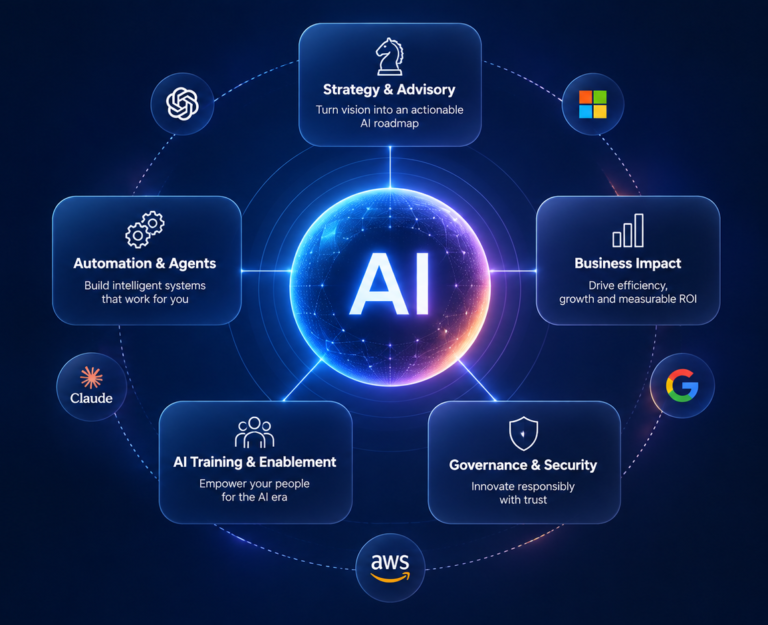
Artificial intelligence is becoming easier to access.
Powerful models are available through APIs. AI assistants can be deployed in hours. Automation platforms can connect systems with relatively little development. New tools appear every week.
For a large organisation, however, access to AI is not the difficult part.
The difficult part is building everything around it.
Before AI can become useful inside an enterprise, someone has to understand the business problem, analyse the process, determine where AI belongs, design how it will interact with existing systems, establish controls, prepare the people who will use it and measure whether it is actually creating value.
The AI model may be the visible part of the solution.
But it is only one component of the system.
Enterprise AI Does Not Start With the Model
One of the most common mistakes in AI transformation is starting with a technology question:
“Which AI should we use?”
For most organisations, that question comes too early.
The better questions are:
What are we trying to improve?
Where are people losing time?
Where are decisions delayed?
Which processes depend on repetitive manual work?
Where does critical knowledge exist only inside the heads of a few employees?
What information would an AI system need before it could make a useful recommendation?
What happens if the system produces the wrong answer?
These are business and operational questions before they are technology questions.
Only after answering them does it make sense to decide what role AI should play.
The AI May Be Powerful. The Process Around It May Not Be.
A sophisticated AI system placed inside a poorly designed process does not automatically create a sophisticated business.
It can simply make the existing problem faster.
Consider an organisation where information is fragmented across an ERP, CRM, spreadsheets, email and several legacy applications.
Adding an AI assistant does not remove that fragmentation.
The AI still needs access to the right information. Someone must determine which data can be trusted, where it comes from, what permissions apply and what happens when different systems disagree.
This is why enterprise AI implementation often becomes a broader transformation project.
The organisation may need to improve the process before it can meaningfully improve the technology.
The Real AI System Is Bigger Than AI
A production AI solution inside a large organisation usually depends on several layers working together:
- Business analysis: understanding the objective, process, users, risks and expected outcome.
- Process design: determining where AI enters the workflow and what happens before and after it acts.
- Technology and integration: connecting AI with the systems, data and applications the business already uses.
- People and adoption: preparing employees to understand, trust, supervise and work effectively with the new capability.
- Governance and measurement: defining controls, accountability and the metrics that determine whether the initiative is actually succeeding.
If one of these layers is missing, the AI may technically work while the initiative itself fails.
That distinction matters.
A successful demonstration is not the same as a successful enterprise implementation.
People Are Part of the Architecture
Enterprise AI discussions often focus heavily on models, platforms and data.
But people are also part of the architecture.
Employees need to understand what the system is designed to do.
Managers need to understand where human judgement remains necessary.
Leadership needs to understand the risks and the expected business outcome.
Operational teams need to know how their workflows will change.
And someone must take responsibility for translating between the technology and the business.
This role is particularly important.
The people designing an AI initiative must be able to understand both sides of the equation: what the technology can do and how the organisation actually operates.
Without that bridge, organisations risk building technically impressive solutions that do not fit the reality of the business.
Analysis Before Automation
There is another temptation when implementing AI: automate immediately.
But automating a process before understanding it can create expensive problems.
A process may contain unnecessary steps that should be removed rather than automated.
A decision may require information that is currently missing.
A manual control may exist because of a regulatory or operational reason that is not obvious from the workflow itself.
A task may look repetitive while actually depending on significant human judgement.
Good implementation therefore begins with analysis.
The objective is not simply to ask:
“Can AI do this?”
It is to determine:
“Should AI do this, where should it do it, and what needs to exist around it for the result to be reliable?”
That is a much more valuable question.
Enterprise AI Requires Design Before Deployment
Large organisations cannot treat AI in the same way an individual user experiments with a new application.
The consequences are different.
A personal AI assistant producing an inaccurate response may be inconvenient.
An AI-supported process interacting with customers, financial information, operational systems or thousands of transactions introduces a different level of responsibility.
Before deployment, organisations need to think about access, validation, exception handling, human oversight, security, ownership and escalation.
They also need to understand what happens when the AI does not behave as expected.
The architecture of failure is just as important as the architecture of success.
That work happens before the majority of employees ever interact with the system.
This Is Why AI Transformation Is a Multidisciplinary Problem
Enterprise AI cannot belong exclusively to IT.
It cannot belong exclusively to management.
And it cannot belong exclusively to an external AI specialist.
Successful implementation requires these perspectives to come together.
Business leaders understand objectives and priorities.
Operational teams understand how work actually happens.
Technology teams understand systems, security and architecture.
AI specialists understand the capabilities and limitations of the technology.
Transformation leaders connect those perspectives and turn them into an executable plan.
The quality of that collaboration often matters more than the choice between two competing AI models.
From AI Tools to AI-Enabled Organisations
The next stage of enterprise AI will not be defined simply by which organisations buy the most AI tools.
Most companies will eventually have access to similar models.
The differentiation will come from how effectively those models are embedded into the organisation.
The companies that benefit most from AI will be those that understand their processes, organise their data, prepare their people and redesign work around the capabilities of the technology.
That is a much deeper change than installing another application.
It is the transition from a company that uses AI tools to a company that is capable of working with AI.
The Technology Matters. The System Matters More.
AI is powerful.
But enterprise value does not come from the model alone.
It comes from the people who understand the problem before implementation.
From those who redesign the workflow.
From the engineers who connect the systems.
From the leaders who define what success means.
From the teams who learn how to work differently.
And from the operating structure that allows all of those elements to work together.
That is why the most important question for a large organisation may not be:
“Which AI should we use?”
It may be:
“Are we building the organisation around AI in a way that allows it to work?”
AI is only one part of the transformation.
At Shift Works, we start with the business, the processes and the people before deciding how technology should be applied.
Through SHIFT™, we help organisations move from AI potential to practical, measurable change.
Explore the SHIFT™ Methodology →
Practical thinking on AI, business transformation and how organisations can turn technology into measurable value.