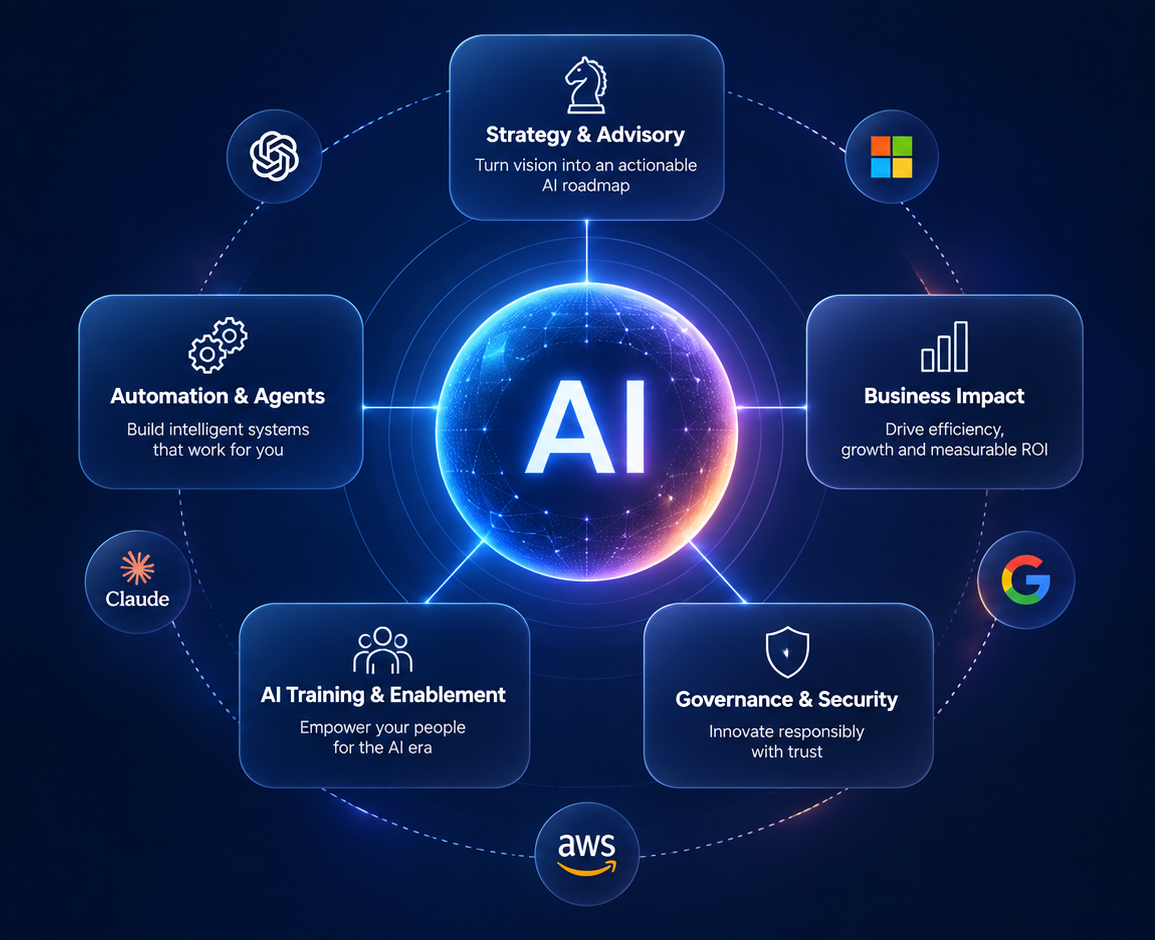
Why enterprise AI transformation starts with processes, people and operating models — not the technology.
Artificial intelligence is becoming remarkably easy to access.
Powerful models are available through APIs. AI assistants can be deployed quickly. Automation platforms can connect applications that previously required significant custom development. New AI products appear almost every week.
For a large organisation, however, access to AI is rarely the real challenge.
The difficult part is deciding where AI belongs, how the work needs to change around it, which systems it needs to interact with and how people will work with it once it is deployed.
That is why enterprise AI transformation should not begin with the question:
“Which AI platform should we use?”
It should begin with a much more important question:
“How should this work actually be done?”
AI Can Improve a Process. It Can Also Accelerate a Bad One.
Most organisations naturally look at AI through the lens of efficiency.
Where can we save time?
Which repetitive tasks can we automate?
Where can AI reduce manual work?
These are useful questions. But they can lead to the wrong starting point.
Imagine a company where an employee receives a customer request by email. The employee reads the message, copies information into a spreadsheet, checks the customer in a CRM, verifies additional information in an ERP, asks a manager for approval and then enters the final result into another system.
It looks like an obvious AI opportunity.
AI could read the email. It could extract the information. It could classify the request and perhaps even prepare a recommendation.
But before automating anything, there is another question to ask:
Why does the process work this way in the first place?
Perhaps the spreadsheet should not exist.
Perhaps the CRM and ERP should already exchange information automatically.
Perhaps the approval step is required only for certain exceptions.
Perhaps employees are repeating work because two systems were implemented years apart and were never properly integrated.
If we simply add AI to the existing workflow, we may successfully automate a process that should have been redesigned.
AI can make a good process dramatically better. It can also make a bad process dramatically faster.
Understand the Real Workflow, Not Just the Documented One
One of the difficulties of business transformation is that the process shown in a diagram is rarely the complete process taking place inside the organisation.
There is the official workflow.
Then there is the workflow people actually follow.
Employees create spreadsheets because the official system does not provide the information they need.
Managers introduce additional checks because of problems that occurred years ago.
Important information travels through email because two platforms do not communicate properly.
Experienced employees know how to handle exceptions that were never documented.
Over time, these workarounds become part of the operating model.
That is why process analysis needs to happen before serious AI implementation.
The organisation needs to understand where work begins, where information comes from, who makes decisions, where delays occur, which steps add value and which steps exist simply because “this is how we have always done it.”
Only then does it become possible to decide where AI can genuinely improve the process.
The Goal Is Not to Automate Everything
Automation is often treated as if removing human involvement is automatically a sign of progress.
It is not.
Some activities are repetitive and provide little value when performed manually. These are obvious candidates for automation.
Other activities require context, judgement, experience, accountability or human interaction.
Those should be treated differently.
The objective is therefore not to design a process with the smallest possible number of people.
The objective is to determine what technology should do and what people should do.
AI might collect information from several systems before an employee starts working on a case.
It might analyse documents and highlight inconsistencies.
It might prepare a recommendation.
It might identify unusual transactions that require attention.
A person can then focus on the part of the process where judgement actually creates value.
That is a much more useful definition of automation.
AI Gives Us an Opportunity to Redesign Work
Traditional automation works best when a process is predictable.
An input enters the system, predefined rules are applied and an expected output is produced.
AI changes some of those limitations.
Modern AI systems can work with language, documents and other less structured information. They can summarise information, classify requests, identify patterns, generate content and assist with decisions that were historically difficult to automate.
This creates an important opportunity.
Instead of asking:
“Where can we insert AI into our existing process?”
organisations can ask:
“If we designed this process today, knowing what AI can do, would we design it the same way?”
Often, the answer is no.
This is one reason Harvard Business Review has described AI as creating renewed opportunities for business-process redesign rather than simply another generation of task automation.
The distinction matters.
The goal is not to automate the workflow you have. It is to design the workflow you should have.
Consider What Happens to the Employee’s Role
Imagine an employee who currently spends thirty minutes gathering information before spending five minutes making a decision.
The obvious automation opportunity is the thirty minutes.
But the deeper transformation is what happens afterwards.
If AI can retrieve the information, organise it, summarise the relevant history and highlight potential issues, the employee’s role changes.
They are no longer primarily an information collector.
Their value moves towards reviewing the analysis, understanding the context, handling exceptions and making the final decision.
The technology has not simply made the employee faster.
It has redesigned the work around the employee.
That is a more significant form of productivity improvement.
People Should Be Involved Before the Technology Is Finished
Employees are sometimes treated as the final stage of an AI project.
The technology is selected.
The solution is developed.
The process is designed.
Then somebody creates a training programme to explain the new system to the people who will use it.
That sequence misses an important source of knowledge.
The people performing the work often understand the workflow better than anyone else.
They know which customer requests regularly create problems.
They know which information is usually missing.
They know which report nobody actually uses.
They understand which exceptions require experience rather than a simple business rule.
And they know which parts of the official workflow are quietly ignored because they do not work in practice.
Their knowledge should therefore influence the design of the AI solution, not simply its adoption afterwards.
Recent McKinsey analysis makes a similar point: organisations capturing value from AI increasingly need to address workflow redesign, operating models, leadership, capabilities and culture rather than treating technology deployment as the whole transformation.
Technology Adoption Is Also Organisational Change
There is another benefit to bringing people into the process early.
It changes the conversation around AI.
If employees suddenly discover that a new AI system will become part of their workflow, the natural response may be uncertainty.
What does this mean for my role?
Will decisions now be automated?
Am I expected to trust the output?
What happens when it is wrong?
These are reasonable questions.
When employees have participated in identifying the problem and improving the process, the discussion becomes different.
Instead of asking what AI is going to do to them, they can participate in deciding what AI can do for the work.
That difference matters for adoption.
BCG’s 2026 global AI-at-work research found that adoption is increasing rapidly, but many organisations are still struggling to convert the time AI saves into organisational value. The research highlights strategic clarity as an important factor in long-term success.
In other words, access and usage alone are not enough.
Enterprise AI Also Has to Work With the Existing Business
Large organisations do not operate inside one application.
A single process may touch an ERP, CRM, eCommerce platform, data warehouse, business intelligence environment, email, document management system and several internally developed applications.
AI needs to operate inside that reality.
This is why integration often becomes as important as the AI itself.
An intelligent system is far less valuable if employees still need to manually copy information between platforms before the AI can use it.
The organisation needs to think about where information lives, which system should be the source of truth, what the AI is permitted to access and where its outputs need to go.
Sometimes the best AI transformation therefore contains relatively little visible AI.
The value may come from combining better integration, cleaner information flows, redesigned processes, automation and AI at exactly the right points.
Governance Has to Be Designed Into the Workflow
There is another major difference between experimenting with AI personally and deploying it inside a large organisation.
The consequences of mistakes are different.
If an individual uses an AI assistant to draft an email and receives a poor response, the impact is usually limited.
If AI participates in a workflow involving customers, financial information, operational decisions, sensitive data or thousands of transactions, the organisation needs significantly more control.
Who is responsible for the output?
When does a human need to review it?
What happens when confidence is low?
Which data can the system access?
How are unusual cases escalated?
How can a decision be investigated later?
How is performance monitored after deployment?
These questions need answers before the system becomes part of normal operations.
NIST’s AI Risk Management Framework explicitly approaches AI risk across organisations that design, develop, deploy or use AI systems. Its purpose is to help organisations operationalise trustworthy and responsible AI rather than treating risk as a one-time technical exercise.
The OECD AI Principles similarly emphasise human oversight, transparency, robustness, security, accountability and systematic risk management throughout the AI lifecycle.
Governance therefore should not sit outside the workflow as a policy document.
It needs to become part of how the workflow operates.
AI Transformation Is a Multidisciplinary Problem
This is why successful enterprise AI cannot belong exclusively to the IT department.
It also cannot belong exclusively to senior management.
And it cannot be delegated entirely to an external AI provider.
Business leaders understand priorities, economics and strategic objectives.
Operational teams understand how work actually happens.
Technology teams understand architecture, integrations, data and security.
AI specialists understand what the technology can and cannot reliably do.
Transformation teams need to connect all of these perspectives.
The quality of that connection can be more important than choosing between two competing AI models.
The model is one component.
The organisation around the model is the system.
Do Not Measure AI. Measure the Business.
There is another trap organisations should avoid.
Measuring whether the AI performs well is necessary, but it is not enough.
A technically impressive AI system can still create very little business value.
The more important questions are operational.
Did the process become faster?
Did employees spend less time on repetitive tasks?
Were mistakes reduced?
Did customers receive faster responses?
Did decisions improve?
Can the organisation handle greater volume without increasing complexity?
Did the cost of operating the process change?
Did employees actually adopt the new way of working?
Those are business outcomes.
McKinsey’s 2026 work on AI operating models argues that the organisations creating an AI advantage are not simply deploying tools; they are redesigning how work and decisions happen, with people and operating models supported by the technology.
That is a useful way to think about the difference between AI deployment and AI transformation.
Start With the Problem, Not the Platform
The AI market is moving extraordinarily quickly.
There will always be another model.
Another agent platform.
Another automation product.
Another impressive demonstration.
Organisations cannot redesign their strategy every time the technology landscape changes.
They need a more durable starting point.
Start with the business.
Understand what you are trying to improve.
Understand how the process works today.
Identify where time, cost, complexity and risk exist.
Understand what employees need.
Define what a better outcome would look like.
Then decide which combination of AI, automation, software, integration and human judgement can create that outcome.
Technology should follow the problem.
Not the other way around.
Before You Add AI, Redesign the Work
AI represents a major opportunity for organisations.
But much of its value will not come simply from inserting an intelligent tool into an existing workflow.
It will come from using the capabilities of AI as a reason to question how the organisation works.
Why does this process require five steps?
Why does the same information exist in three systems?
Why does somebody create this report every week?
Why does this decision require thirty minutes of preparation?
Why are employees manually moving information that systems could exchange automatically?
Why is a highly experienced person spending hours performing work that requires very little of their actual expertise?
These are transformation questions.
And AI gives businesses a new reason to ask them.
The organisations that create the greatest value from AI may therefore not be the ones with access to the most sophisticated models.
Most large businesses will eventually have access to similar technology.
The difference will be in how intelligently they redesign the organisation around it.
The processes.
The systems.
The governance.
And, most importantly, the people.
Because the objective is not simply to put AI into the workflow.
The objective is to build a better way of working.
From Workflow to Transformation
At Shift Works, we believe AI transformation starts with the business — not with the technology.
Through the SHIFT™ methodology, we help organisations understand where value can be created, redesign processes, align people and technology, implement the right solutions and turn AI potential into measurable operational change.
Explore the SHIFT™ Methodology →
Sources & Further Reading
McKinsey & Company — “The Operating Model Advantage: Why AI Winners Are Rewiring Their Organizations” — July 2026
Explores why meaningful AI value comes from redesigning how work is done, how decisions are made and how operating models support AI at scale.
Read the McKinsey article
McKinsey & Company — “Rewired Takes: Practical People Lessons for Scaling AI Adoption” — July 2026
Focuses on the people side of AI transformation, including workflow redesign, leadership, operating models and organisational culture.
Read the McKinsey article
Boston Consulting Group — “AI at Work: Why Strategy Matters More Than Tools” — June 2026
Shows that AI adoption is accelerating, but many organisations still struggle to convert productivity gains into measurable business value without strategic clarity.
Read the BCG research
Harvard Business Review — “How AI Is Helping Companies Redesign Processes” — March 2023
Examines how AI is bringing business-process redesign back to the centre of enterprise transformation rather than simply automating existing tasks.
Read the Harvard Business Review article
National Institute of Standards and Technology — Artificial Intelligence Risk Management Framework (AI RMF 1.0)
A practical framework for organisations designing, developing, deploying or using AI systems, with a focus on trustworthy and responsible AI risk management.
Read the NIST AI Risk Management Framework
OECD — OECD AI Principles
International principles for trustworthy AI, covering human-centred values, transparency, robustness, security, accountability and responsible AI governance.
Read the OECD AI Principles
Practical thinking on AI, business transformation and how organisations can turn technology into measurable value.