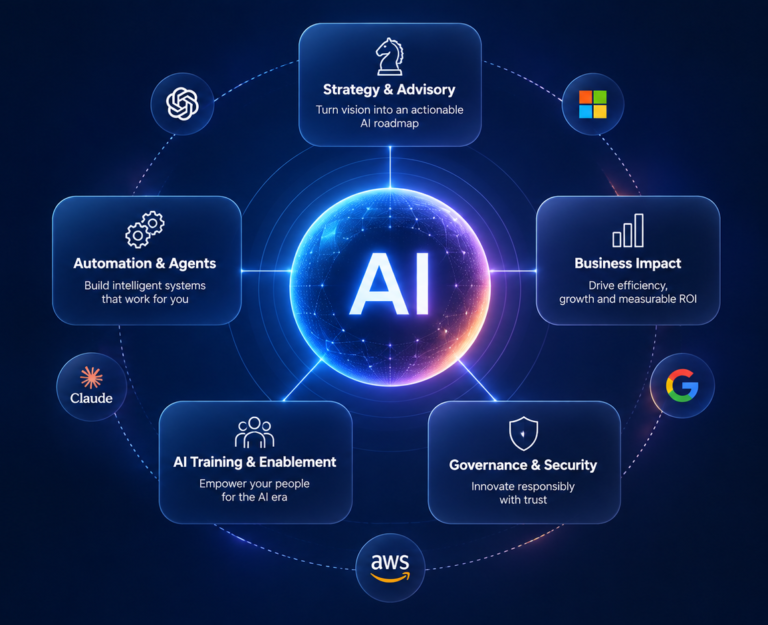
AI pilots are everywhere. Enterprise transformation is not. The difference lies in an organization’s ability to connect strategy, technology, people and execution around measurable business outcomes.
Artificial intelligence has moved rapidly from an emerging technology discussion to a boardroom priority.
Across industries, organizations are experimenting with generative AI, copilots, automation platforms, intelligent assistants and increasingly sophisticated AI agents. Teams are testing new tools. Departments are launching pilots. Executives are asking where AI can improve productivity, reduce costs, accelerate decision-making and create new sources of competitive advantage.
The level of activity is significant.
But activity is not transformation.
For many organizations, AI adoption remains fragmented. One department introduces an AI assistant. Another experiments with automated reporting. A third builds a proof of concept around customer service. Employees independently use public AI tools to accelerate parts of their work.
Each initiative may create value locally.
Yet the organization itself has not fundamentally changed.
This creates one of the most important challenges facing business leaders today:
How do you move from experimenting with AI to operating as an AI-enabled organization?
The answer is not simply to deploy more AI tools.
Enterprise AI transformation requires a coordinated approach that connects business strategy, operational processes, technology, governance, workforce capabilities and measurable outcomes.
And that transition is considerably more difficult than launching a pilot.
The AI Experimentation Trap
Experimentation is an essential part of innovation.
Organizations need space to test technologies, validate assumptions and understand where AI can realistically create value.
The problem begins when experimentation becomes the operating model.
A successful proof of concept can create the illusion that an organization is further along its AI journey than it actually is.
A team may demonstrate that AI can automate a process.
But several questions remain unanswered:
Can it operate reliably at scale?
Can it integrate with existing systems?
Can employees incorporate it into their daily workflows?
Can the organization govern the data it uses?
Can performance be monitored?
Can security and compliance requirements be maintained?
And, critically:
Can the organization prove that the implementation creates measurable business value?
Moving from prototype to production exposes complexities that are often invisible during experimentation.
This is why organizations should distinguish clearly between three different stages:
AI Experimentation
Testing what AI can do.
AI Implementation
Integrating AI into real business processes.
AI Transformation
Redesigning how the organization operates because AI capabilities now exist.
These are fundamentally different levels of maturity.
Many companies are currently somewhere between the first and second.
The strategic opportunity lies in reaching the third.
AI Transformation Starts With the Business — Not the Technology
One of the most common mistakes in AI programs is beginning with the technology.
Organizations discover a new model, platform or AI agent and immediately ask:
“Where can we use this?”
A stronger question is:
“Where does our organization currently lose time, money, capacity or opportunity?”
That distinction changes the entire conversation.
Instead of searching for applications for a technology, the organization begins identifying business problems worth solving.
Consider the operational reality of most companies.
Employees repeatedly transfer information between systems.
Customer service teams answer similar questions hundreds of times.
Sales professionals spend significant time preparing proposals and updating CRM systems.
Finance teams manually reconcile information.
Managers spend hours producing reports.
Operations teams search across documents, emails and internal systems to find information required for decisions.
Knowledge is often fragmented across applications, departments and individuals.
These are not AI problems.
They are business problems.
AI becomes valuable when it can improve them.
This is why enterprise AI strategy should begin with process discovery and opportunity identification rather than technology selection.
The objective is not to maximize the number of AI initiatives.
It is to identify the small number of high-value opportunities capable of producing meaningful business impact.
Not Every AI Opportunity Deserves Investment
Once organizations begin examining their processes, they often discover dozens — sometimes hundreds — of potential AI use cases.
This creates another problem.
Prioritization.
Without a structured framework, organizations may select projects because they are technically interesting, politically visible or easy to demonstrate.
But the most impressive AI demonstration is not necessarily the best investment.
AI opportunities should instead be evaluated across several dimensions.
Business Impact
What happens if this process improves?
Could it reduce operational costs?
Increase revenue?
Improve customer experience?
Reduce errors?
Accelerate decision-making?
Increase employee capacity?
Frequency
A small improvement applied thousands of times can create significantly more value than a major improvement applied occasionally.
Scalability
Can the solution be reused across teams, departments or markets?
Implementation Complexity
What systems, integrations, data and organizational changes are required?
Risk
What are the implications for security, compliance, privacy, accuracy and business continuity?
Measurability
Can the organization establish a baseline and demonstrate improvement?
The goal is to identify opportunities where business value is high and implementation complexity is manageable.
These initiatives create momentum.
They also help organizations develop the capabilities required for more ambitious transformation.
The Real Unit of AI Transformation Is the Workflow
Organizations frequently think about AI in terms of tools.
Chatbots.
Copilots.
Large language models.
Agents.
Automation platforms.
But employees do not operate in tools.
They operate in workflows.
A customer inquiry may involve email, CRM data, internal documentation, pricing systems, approvals and communication between multiple departments.
A sales proposal may require research, CRM information, historical proposals, pricing rules and management approval.
A procurement decision may involve supplier data, ERP systems, contracts, inventory information and financial constraints.
Deploying AI into one isolated step may improve that step.
But redesigning the entire workflow can create significantly greater value.
This is where the transition from AI implementation to AI transformation begins.
Instead of asking:
“How can AI help employees perform this task?”
Organizations begin asking:
“If AI capabilities existed throughout this workflow, how should the workflow operate?”
That question opens the door to fundamental process redesign.
Tasks may disappear.
Approvals may become automated.
Information may move automatically between systems.
AI agents may coordinate activities across applications.
Employees may shift from executing repetitive work to supervising, validating and making higher-value decisions.
This is not simply automation.
It is operating model redesign.
AI Agents Will Accelerate This Shift
The emergence of agentic AI represents an important evolution in enterprise AI.
Traditional generative AI primarily responds to requests.
AI agents can increasingly pursue objectives.
They can reason across information, interact with tools, execute sequences of actions and coordinate multiple steps within a workflow.
Consider a traditional sales process.
A salesperson receives a new opportunity.
They research the company.
Review previous communication.
Identify relevant products.
Prepare a proposal.
Update the CRM.
Schedule follow-ups.
Coordinate internally.
An AI-enabled workflow could potentially perform significant portions of this process automatically.
The agent could gather information from authorized sources, summarize the opportunity, retrieve relevant historical data, prepare a first proposal, update internal systems and recommend next actions.
The employee remains responsible for judgment, relationships and important decisions.
But the surrounding administrative workload changes dramatically.
This pattern can be applied across customer service, finance, procurement, HR, operations, marketing and many other functions.
However, agentic AI also increases the importance of architecture, governance and process design.
Giving an AI system the ability to take actions introduces fundamentally different risks from allowing it simply to generate text.
Organizations therefore need to think beyond model performance.
They must define permissions, boundaries, escalation mechanisms, auditability and human oversight.
Technology Alone Cannot Create Adoption
Even technically successful AI implementations can fail commercially.
The reason is simple.
Business value only appears when people actually use the new capability.
Employees need to understand what the technology does.
They need to understand where it should be used.
They need confidence in its outputs.
They need clear guidance regarding security, privacy and acceptable use.
And perhaps most importantly, they need to understand how their own role changes.
AI transformation therefore cannot be treated exclusively as an IT initiative.
It is also an organizational change program.
Training becomes essential.
But effective AI training should go beyond teaching employees how to write prompts.
Employees need to understand how AI fits into their specific responsibilities.
A finance professional should learn different applications from a salesperson.
A manager needs different capabilities from a customer service representative.
A developer requires a different level of technical understanding from an executive.
Training should therefore become increasingly role-specific and workflow-specific.
The objective is not simply AI literacy.
The objective is AI-enabled performance.
Leadership Alignment Is Critical
AI transformation crosses organizational boundaries.
Technology teams understand architecture and security.
Business units understand operational problems.
Finance understands investment requirements and expected returns.
Legal and compliance teams understand regulatory exposure.
HR understands workforce implications.
Leadership determines strategic priorities.
If these groups operate independently, AI initiatives become fragmented.
Enterprise transformation therefore requires clear ownership.
Organizations need to define:
Who owns the AI strategy?
Who prioritizes use cases?
Who approves investments?
Who defines technical standards?
Who manages risk?
Who measures outcomes?
Who is accountable when an AI-enabled process fails?
These questions become increasingly important as AI moves deeper into core business operations.
Without clear governance, organizations risk creating an uncontrolled collection of tools, vendors, models and isolated implementations.
With appropriate governance, AI becomes a managed organizational capability.
Data and Integration Determine What Is Actually Possible
AI demonstrations often operate in controlled environments.
Enterprise systems do not.
Real organizations contain decades of technology decisions.
ERP systems.
CRM platforms.
Databases.
Cloud applications.
Legacy software.
Documents.
Emails.
Spreadsheets.
APIs.
Custom applications.
And significant amounts of institutional knowledge that may never have been formally documented.
For AI to become genuinely useful, it often needs access to this environment.
That makes integration one of the most important — and frequently underestimated — components of AI transformation.
The challenge is rarely whether an AI model can generate an answer.
The challenge is whether it can access the right information, at the right time, under the right permissions, and interact safely with the systems required to complete the process.
This is where strong engineering becomes critical.
AI transformation requires more than AI expertise.
It requires understanding software architecture, APIs, data models, authentication, security, infrastructure, observability and enterprise integration.
The intelligence layer may be new.
The engineering disciplines required to operate it reliably are not.
Governance Must Enable AI — Not Stop It
As AI adoption expands, organizations face legitimate concerns.
Sensitive data.
Intellectual property.
Model accuracy.
Regulatory requirements.
Cybersecurity.
Bias.
Third-party platforms.
Decision accountability.
Organizations typically respond in one of two ways.
Some move too quickly and introduce unnecessary risk.
Others create such restrictive policies that employees simply continue using AI unofficially.
Neither approach is sustainable.
Effective AI governance should create controlled acceleration.
Employees should know which tools are approved.
Teams should understand what information can be processed.
High-risk activities should require stronger controls.
AI-generated decisions should have appropriate levels of human oversight.
Systems should maintain logs where necessary.
Models and vendors should be evaluated according to the sensitivity of the use case.
The objective of governance should not be to prevent AI adoption.
It should make responsible adoption possible.
From Productivity Gains to Operating Model Transformation
The first wave of enterprise AI value is largely about productivity.
Write faster.
Research faster.
Summarize faster.
Analyze faster.
Code faster.
Respond faster.
These improvements matter.
But they represent only the beginning.
The larger opportunity emerges when organizations redesign processes around AI capabilities.
Imagine reducing a process from twelve manual steps to four.
Imagine moving from weekly reporting to continuous intelligence.
Imagine customer requests being analyzed, classified and routed instantly.
Imagine internal knowledge becoming accessible through natural language.
Imagine routine operational decisions being prepared automatically for human approval.
Imagine AI agents coordinating work across multiple enterprise systems.
At that point, the organization is no longer simply using AI.
AI has changed how the organization operates.
That is transformation.
Measurement Separates Transformation From Innovation Theatre
AI initiatives need measurable objectives.
Without them, organizations risk celebrating technological achievements without understanding whether they created economic value.
Every significant AI initiative should establish a baseline.
For example:
Average handling time before implementation.
Cost per transaction.
Hours required to complete a process.
Error rate.
Conversion rate.
Customer response time.
Employee capacity.
Revenue per salesperson.
Time required to produce management information.
The organization can then measure the effect of the AI-enabled workflow.
This changes the conversation.
Instead of:
“We deployed an AI assistant.”
Leadership can say:
“We reduced average processing time by 38%, increased capacity by 22% and recovered 1,400 employee hours per quarter.”
That is the language of transformation.
It is also the language executives, boards and investors understand.
A Structured Path From Experimentation to Transformation
Successful AI transformation does not happen through isolated technology deployments.
It requires progression.
At SHIFT WORKS, we think about this journey through five interconnected stages.
Strategize
Understand the organization, identify high-value opportunities and define measurable objectives.
AI begins with business strategy.
Harmonize
Align leadership, teams, processes, data and technology around the transformation priorities.
This creates the organizational foundation required for execution.
Implement
Build and integrate AI solutions into real operational environments.
This is where strategy becomes working capability.
Foster
Develop the skills, confidence and operating behaviors required for adoption.
Technology creates potential.
People turn that potential into performance.
Transform
Scale successful implementations, redesign workflows and continuously measure business impact.
AI becomes part of how the organization operates rather than another technology initiative.
These stages form the SHIFT™ Methodology.
The objective is not simply to introduce artificial intelligence into an organization.
It is to systematically convert AI capability into measurable business value.
The Competitive Advantage Will Not Be Access to AI
AI technology is becoming increasingly accessible.
Models will improve.
Costs will fall.
Capabilities will become commoditized.
Most organizations will eventually have access to similar AI technologies.
That means access itself will not create sustainable competitive advantage.
The advantage will come from something more difficult to replicate:
the organization’s ability to apply AI effectively.
Companies that understand their processes.
Companies that have strong data foundations.
Companies that can integrate technology quickly.
Companies that develop AI-capable employees.
Companies that establish effective governance.
Companies that continuously identify, implement and scale high-value use cases.
These organizations will move faster than competitors even when both have access to the same underlying models.
AI maturity will therefore become an organizational capability rather than a technology advantage.
The Question Has Changed
A few years ago, business leaders were asking:
“Should we use AI?”
That question has largely been answered.
Today the question is:
“Where should we use AI?”
Soon, the question will become more fundamental:
“How should our organization operate now that AI exists?”
That is the question that defines transformation.
The organizations that answer it early will not simply automate existing work.
They will redesign how work gets done.
They will create faster decision cycles.
They will operate with greater leverage.
They will build new customer experiences.
They will unlock capacity that previously did not exist.
And they will develop an organizational capability that becomes increasingly difficult for competitors to replicate.
The transition from AI experimentation to enterprise transformation is therefore not primarily a technology journey.
It is a business transformation journey enabled by technology.
And the organizations that understand that distinction will be the ones most likely to convert the extraordinary capabilities of AI into something far more important: measurable, sustainable business value.
Practical thinking on AI, business transformation and how organisations can turn technology into measurable value.